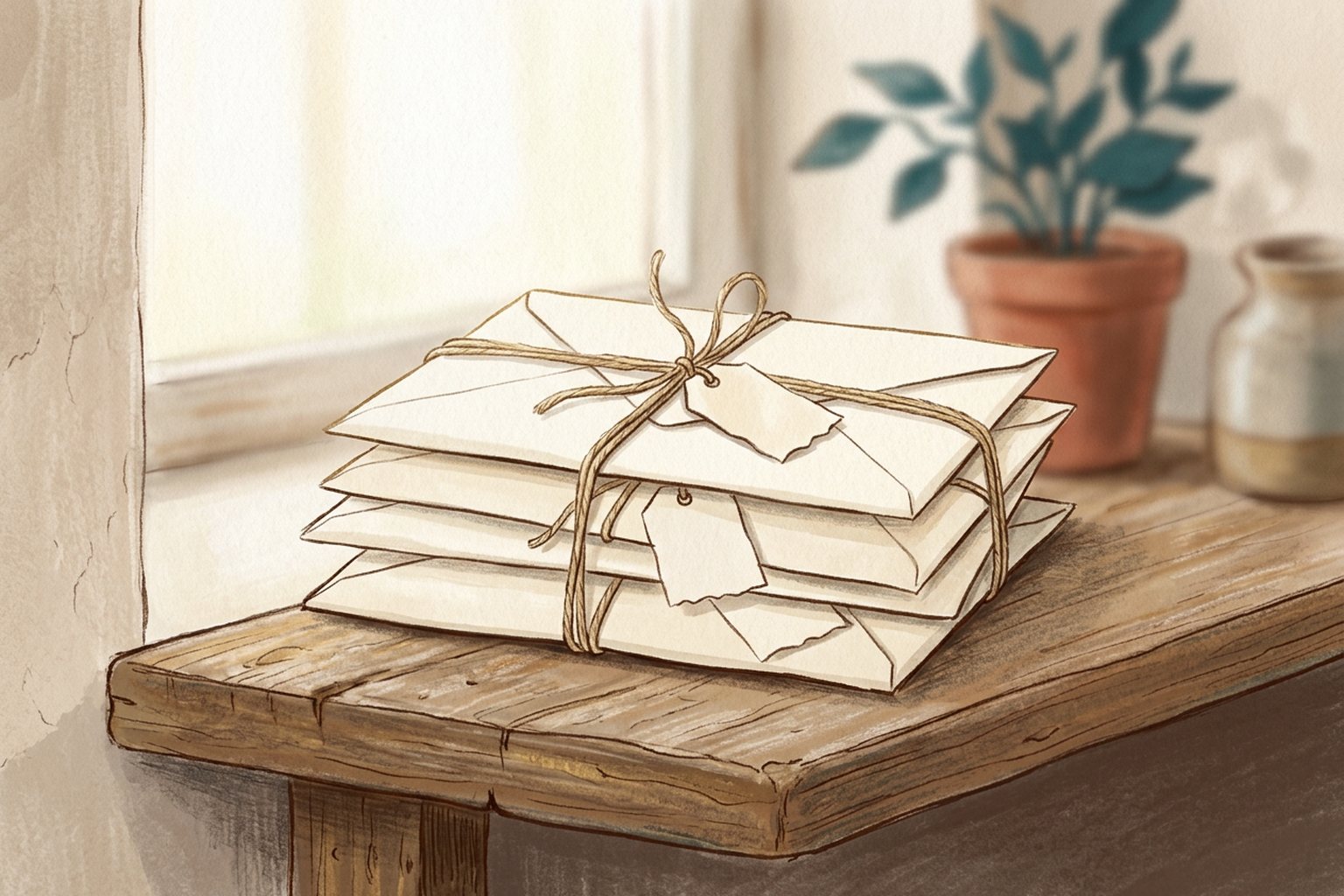
“Open when you miss me.” “Open when you cannot sleep.” Friends, couples and families write whole stacks of open-when letters, each in its own envelope with a label on the front.
Almost all of them are written to someone else. This article turns the idea around. You write the stack for yourself, and a date, not a person, decides when each one arrives.
The idea and its one problem
An open-when letter is written for a particular moment. The envelope tells you what the moment is, and you open it only when it arrives. That is the charm, and it is also the weak spot. Somebody has to hold the envelopes, and if you wrote them yourself, you are holding your own stack. Sooner or later you will peek.
A dated email solves that neatly. You cannot open it early, because it does not exist in your inbox yet. On the day you chose, we email it to you between 8:00 and noon in your time zone, and you read it when you sit down with it.
The trade is that you pick a date, not a mood. So the work is in choosing moments you can place on a calendar.
Letters for a day you know
Some moments have a date attached. These are the easiest to write.
- The day exam or application results are due
- Your first Monday at a new job
- The first anniversary of a big decision
- The first winter in a new city
- The week a long project is meant to be finished
- A birthday after a hard year
Write each one to the person who will be reading on that day. If it is results day, that person is a little nervous and wants company. If it is the first Monday of the job, they want a reminder of why they said yes.
Letters for a day you cannot predict
Many open-when moments depend on news you do not have yet. You cannot schedule “the day I hear back” because you do not know which day that is.
Here is a workable way around it. Write one letter that is meant to be read whatever the news turns out to be. Do not try to predict the result. Pick the most likely day, or a day or two after it, and write the letter so that it fits good news and bad news equally well. Say what you hope for, say what you would want to hear if it goes the other way, and remind yourself why you went for it in the first place.
A few cautions help here. We email it at some point between 8:00 and noon, so it will not be there at dawn for an early appointment. For anything that starts in the morning, send it the day before. And if the news arrives later than you expected, the letter will simply wait in your inbox until you are ready to read it.
Ten open-when ideas for you
Pick two or three that suit your year.
- Open on the morning of a big day, sent the day before.
- Open on the day of an appointment you have been dreading.
- Open on the day your lease ends.
- Open on a Sunday in the grayest part of winter.
- Open on the anniversary of the day something ended.
- Open when you have been away from home for six months.
- Open on the last day of a year you almost did not get through.
- Open on a birthday you are not looking forward to.
- Open in the week after a big move.
- Open in a season you tend to find difficult.
What makes a good open-when letter
Keep each one short, a page at most, and give it one job. A letter that tries to cheer you up, make plans and settle an old argument will do none of them well.
Put the occasion in the first line, the way an envelope would: “Open on the day the results arrive.” That sentence helps your reader at once, and it reminds you what you meant to say when you wrote it.
Write for the mood you can predict. On results day you will probably be tense. On a gray Sunday you may be low. Choose words you would want to hear in that state: warm, concrete, not too long. Add a line giving yourself permission to close the email unread if today turns out not to be the day. And skip advice about things you do not yet know. You can only describe what is true on the day you write.
What a date-based letter cannot do
There are a few honest limits. A saved letter cannot be edited or cancelled on the site, so be sure of your date and your words before you send. The letter goes to the email address you give, and that address has to still be yours on the day the letter is sent. There are no reminders, and nothing is emailed when you write, so keep a copy of anything you care about. Letters are stored as plain text, so leave out passwords and anything you would not want others to read.
You can write several letters in one sitting, each with its own date. Once you have confirmed your email address with the 6-digit code, writing the next one takes only a few minutes.
One thing to know before you build a stack: every letter email carries an unsubscribe link, and using it stops all the letters still scheduled for that address, not only the one in front of you.
A sample letter for a day you cannot predict
Dear future me,
You are reading this on the day the program decides. I do not know which way it went, so I wrote this to work either way. If it is a yes, go and tell the people who helped, and then sit down for a minute before the planning starts. If it is a no, take the evening off, eat something warm, and remember that I applied because I wanted the work, not because I wanted the answer. The work is still there. So are you.
[your name]
Write it now
Think of one day in the next year that you already know will be a little hard or a little important. Write the letter you would like to find in your inbox that morning, put the occasion in the first line, and choose the date. Then do it once more for a second day.