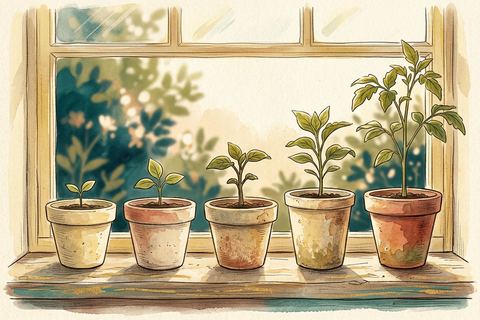
Progress in a language is hard to see while it is happening. You study most weeks, the words from last spring feel as if you always knew them, and the gap between where you were and where you are closes without a sound. A letter can make it visible. Write one now, in the language you are learning, and read it in a year as if a stranger had written it.
The trick is to treat the letter as a measurement, not a diary entry. You answer five fixed questions under fixed conditions, then answer the same five later in the same way. Put side by side, the two letters show what you can do now that you could not do then.
The method in four steps
- Write the first letter today, in the language you are learning, answering five fixed questions.
- Choose a delivery date between three months and a year ahead.
- When the letter is in your inbox, read it, then write a new one with the same questions.
- Put the two side by side and count what changed.
Nobody grades either letter. You are not practicing grammar here. You are building something to measure against.
Five questions that never change
The questions matter more than the answers, and each one tests something different. Use these five, or choose your own, but once you have chosen, do not touch them.
- Who are you, and what does an ordinary day look like?
- What did you do last weekend?
- What do you plan to do next month?
- Describe one person you know well.
- What three questions would you ask yourself in a year?
The first question collects everyday nouns and the present tense. The second needs the past, the third the future, and the fourth adjectives and the way you talk about people. The last one needs question forms, which many learners avoid for months.
Copy the questions word for word to the top of the letter. Write them in the language you are learning if you can, and in your own language if you cannot yet. Next year, use exactly the same wording. If the wording changes, the comparison turns into a guess.
Write at your real level
This is the hard part. The pull is to look up every word, polish every sentence and produce the best letter you can. Resist it. A polished letter shows how good you are with a dictionary open, and the dictionary will still be there next year. What you want to record is what you can do on an ordinary day.
Set the rules before you start, and write them under the questions so you can repeat them later:
- Twenty minutes, one sitting.
- No translation tool and no dictionary.
- When a word is missing, write [?] and put the word in your own language beside it.
- No corrections afterward, from you or from a teacher.
The [?] marks are the most useful thing in the letter. Each one is an exact record of something you wanted to say and could not. Next year you will count them, and you will see which of those very gaps have closed.
A scheduled letter cannot be edited, which suits this exercise. The version you send is the version you get back, mistakes included.
Choose the date
Pick a date far enough away that a change is real. Three months fits an intensive course. Six months suits a steady weekly routine. A year is the safest default, because even slow stretches add up to a visible difference. The calendar accepts any date from tomorrow up to 20 years ahead, and choosing the delivery date goes through the trade-offs.
We email the letter to you on that day, between 8:00 and noon in your time zone. Use an address you expect to still have. If you plan to chain the letters, writing the second one the day the first comes back and scheduling it for another year or half-year, remember that the unsubscribe link in any of our emails, including the one-tap button some mail apps show, stops every letter still waiting for that address.
Read it, then answer again
Read the old letter before you do anything else. Expect to wince a little. Then write the second letter under the same rules: the same questions, the same twenty minutes, no dictionary, and no peeking at the old answers while you write. Only when the second letter is finished do you lay the two next to each other.
If you work with a teacher or a study partner, ask them to keep the questions fixed too, and show them nothing until both letters exist.
What to count
Do not give yourself a grade. Count things instead:
- Length: how many words you wrote in twenty minutes.
- Gaps: how many [?] marks, and which ones closed.
- Tenses: which ones appear now that were missing before.
- Connectors: words like “because”, “although” and “so that”.
- Topics: what you can write about now that you could not then.
- Mistakes you can now spot in the old letter.
That last item is the quiet proof. A year ago those errors were invisible to you. If you can circle one in the first letter, you have learned something, even if the second letter has errors of its own.
Before and after: a pair of letters
Here is what a pair can look like. Both were written in the learner's second language and are translated into English here, so you can see the level without reading the original. The first was written on day one.
Dear future me, I live in a small city. I work in a shop, and every day is almost the same. I have one brother, he is tall and funny. Last weekend I [?: walked] to the park with a friend. It was good. Next month I want to go to the sea. Are you better now? Do you understand films? Do you still study every day? [your name]
The second was written twelve months later, to the same five questions.
Dear past me, I just read your letter and laughed at “It was good.” Now I run the morning shift at the shop, and I read the news on the bus. Last weekend I walked by the sea with my brother, although it rained, so we ended up in a small cafe talking with the owner for an hour. I did not need to look up a single word. Next month I will start an evening course, because I want to read a whole novel by spring. What is the novel? Who did you talk to first? Is the course hard? [your name]
Look at what the second letter does that the first cannot. It joins two ideas with “although” and “because”. It tells a small story with a turn in it. Its day has a rhythm instead of a label. The word in brackets is gone, and the questions at the end ask for something specific. None of this needed a test to show up. It was visible because the questions stayed the same.
When the second letter looks worse
It can happen. Some months are flat, and a letter written after a quiet stretch may be shorter and shakier than you hoped. Read it for information, not for a verdict. Check the gaps and the mistakes you can now see before you decide that nothing happened.
If it does show a stall, you have learned something useful about your practice, and practice can change. Write the next letter for six months ahead and look again.
One skill out of four
A letter measures writing under easy conditions: no one waiting for your answer, time to think. It says nothing about listening or about speaking in real time. It does not replace a teacher, a course or a conversation with a person, and it has no pass mark. Its only job is to give you a fixed point to look back at.
Language, address and privacy
The language of the page and the language of your letter are separate. You can use the site in your own language and type the letter in the one you are learning. The text is emailed as you typed it, in whatever language you wrote. Letters are stored as plain text on our server, so leave out anything private.
Write it now
Open the form, copy the five questions to the top of a new letter, and set a timer for twenty minutes. Write the rules under the questions, then answer as you are today, gaps included. Choose a date a year ahead, and leave the gaps for the person who opens it to close.