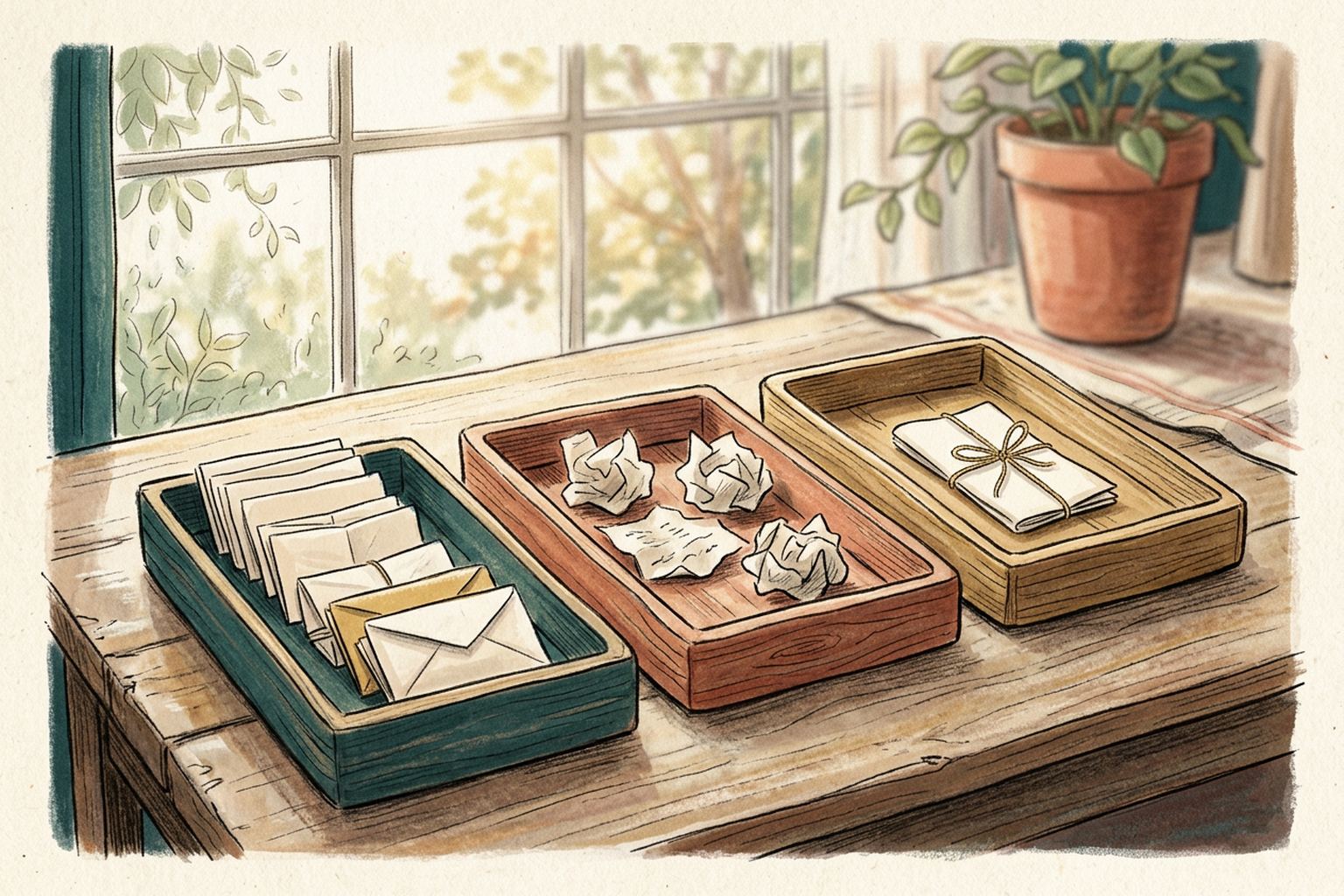
Almost everyone carries a someday list. Learn to swim properly. Visit the town a grandparent left. Call the friend you stopped calling. Repaint the hallway. The list lives in your head, grows slowly, and answers to nobody.
A letter gives it a reader. You write the list down as it really is, sort it, and choose a delivery date a year or two away. The person who opens the letter checks it against the life that actually happened. Nobody expects every line to be crossed off. The point is to find out which ones were never really yours.
Empty the list
Set a timer for ten minutes and write every someday you can think of, one per line. Do not stop to judge. The embarrassing entries count, and so do the ones that are ten years old and no longer feel right.
Keep to a few rules while you write:
- Write each entry the way you say it to yourself, not the way you would say it to others.
- Let small things sit next to big ones: “fix the zipper” beside “live by the sea”.
- Do not rank, merge or tidy anything yet.
- Stop when the timer stops, even if the list is short.
Most lists run to twelve or twenty lines. Fewer is fine. A short honest list is worth more than a long one built to impress a reader who is you.
Sort it into three columns
Read the list once, then give every line one of three labels. On paper you can draw three columns. In a letter, a word after each line does the same job.
- Still true. You would be glad if it happened, and you would say so out loud.
- No longer mine. It was yours once, or it belonged to someone else all along: a parent's wish, a friend's plan, a picture of a life you saw somewhere.
- The one that scares me. You want it, and the wanting comes with a tight stomach.
Keep the third column small. One or two entries is usual. If six lines landed there, some of them are probably “still true” with a worry attached, so move them back and keep the worry in mind.
Do not feel bad about the middle column. Crossing a line out is not failing at it. A list that never loses a line is a list nobody has read.
Quote the sentence that puts it off
Next to each “still true” entry, write the sentence you use to postpone it. Quote it exactly as it sounds in your head: “When the kids are older.” “After the loan is paid.” “Once work calms down.” “When I am fitter.”
Do not argue with the sentence and do not fix it. Just copy it down.
When the letter arrives, these sentences are the most revealing part. Some will turn out to be real reasons. Others will read, a year later, like a line you have repeated so long you stopped hearing it.
Add a cost line
Wanting and postponing look the same from the inside. A cost line tells them apart. Under each “still true” entry, write what it would take in three small units: hours, money, and one awkward step such as making a phone call, asking for leave or saying the wish out loud.
For swimming it might read: “Eight evenings at the pool, about the price of a pair of boots, and admitting to the instructor that I cannot float.” For repainting the hallway: “Two weekends, one tin of paint, and moving the shoe rack.”
Often the cost is smaller than the postponing sentence suggested. Sometimes it is larger, and the entry belongs in the middle column after all. Either way you now know something you did not know an hour ago.
Choose the date
Twelve to 24 months works well. That is short enough that you will still recognize the list and long enough for life to move. The calendar accepts any date from tomorrow up to 20 years ahead, and choosing the delivery date goes through the trade-offs. A birthday or the first Monday of a year can add a small sense of occasion, but an ordinary date reads just as well.
We email the letter to you on that day, between 8:00 and noon in your time zone. Use an address you expect to keep, since a work or school address may close before the letter comes due.
A saved letter cannot be edited. For this exercise that is a gift: the list that comes back is the list you wrote, postponing sentences and all.
A sorted list, as an example
Here is how one list of nine lines sorted out.
- Still true: learn to swim, call my sister, see the northern coast in autumn, repaint the hallway.
- No longer mine: run a marathon, learn the violin, own a house with a garden.
- The one that scares me: apply for the evening design course.
- Left over: one line that fit nowhere, “learn to say no”, which was kept for the second round.
And the letter that carries it, short enough to write in one sitting:
Dear future me, Here is my someday list as of today, sorted. Still true: learn to swim, call my sister, see the northern coast in autumn, repaint the hallway. No longer mine: the marathon, the violin, the house with a garden. The one that scares me is the evening design course. My excuse for swimming is “once work calms down”, and the lessons cost eight evenings. I want to know which of these you did, which you dropped without noticing, and whether you said the word someday out loud to anyone. Be kind about the hallway. [your name]
Notice what the letter leaves out. It does not promise anything, and it does not ask for a plan. It lists, sorts and asks.
Reading it a year later
When the letter arrives, read it once without a pen. Then go through it with a pen and do three things:
- Mark what moved: done, started or tried.
- Mark what you dropped without noticing. These are usually in the first column. Ask whether you meant to let them go.
- Read the postponing sentences aloud. Which are still true, and which are only habit?
Count, do not grade. The number of lines that moved is information. So is the number you dropped without a thought, and the number that appeared on the new list but not the old one.
Then sort the list again. A second list written after reading the first shows how your wanting has changed, and you can send it to yourself for another year or two. Each round trims the list a little, and a shorter list is easier to act on.
When the scary one is heavy
Sometimes an entry frightens you because it sits near something painful: a health worry, a loss, a conflict that has not settled. A letter is a fine place to name it. It is not a replacement for a doctor, a counselor or a friend who can talk it through with you. If the entry feels bigger than a list can hold, ask someone you trust for that help, and keep the letter for the lines that are only waiting for a date.
What goes in, and what stays out
A someday letter is not a bucket list to complete and not a promise. It has no pass mark. Its job is smaller: to put your list in front of a reader who can compare it with real life.
Letters are stored as plain text on our server, so keep anything very sensitive out of the list. A line such as “talk to him” is enough. The details can stay with you.
Write it now
Set a timer for ten minutes and empty the list into the form. Sort it into the three groups, quote the sentence you use to put each one off, and choose a date a year or two away. Whatever comes back, you will know which somedays were real.